Tuesday, October 13, 2015

An Excursion Into Egypt

In October 2006, my wife Diane and I made a port of call in Alexandria, Egypt, while on a 12-day cruise aboard the Norwegian Jewel from Athens, Greece, to Istanbul, Turkey. Ours was the first cruise since the terrorist attacks in September 2001 that was allowed to make overnight excursions to Cairo. Everyone participating got on their assigned buses and then all 13 of them pulled out the port and drove bumper-to-bumper at about 70 miles an hour with police cars leading and following and a plainclothes policeman with a submachinegun on board each. 

Below, the relatively unimpressive modern lighthouse of the port is a reminder that Alexandria was once home to the Pharos, one of the Seven Wonders of the Ancient World.  

Here the vast size of the Great Pyramids, the only one of the Seven Wonders of the Ancient World that still exists, is evident by a view of them from the outskirts of the city.


Above left, Diane stands in front of the 19th-century Mosque of Muhammad Ali in Cairo, respectfully attired to enter it. Above right top, an interior view of the main area within the mosque. Above right bottom, a detail of the nearby sprawling 12th-century Citadel of Cairo, constructed by the famed Muslim general Saladin. 

Above left, a view from the Citadel across the smoggy sprawl of Cairo toward the Great Pyramids in the suburb of Giza. Above right, a whirling dervish, a type of mystic that achieves ecstasy through a spinning dance, who we had the opportunity to see during a Nile dinner cruise. The real highlight of that night, however, was being seated with and meeting Richard and Laura Allan, with whom we have been close friends ever since! 

Above is the massive Sphinx of Memphis. Our Egyptian guide, Hanan, spoke pretty good English but sometimes got key words confused, as when she described this statue to us: "It is ver-ry heavy ... It weighs 90 pounds!" (Its actual weight is, of course, approximately 90 tons.) 

 
Above left, Diane demonstrates how to "walk like an Egyptian"! (Note that we did not actually see any Egyptians walking like this during our trip.) Above center, Diane and I at the Step Pyramids of Saqqara, which predate the Great Pyramids of Giza. Above right, Diane and some of our traveling companions in one of the temples at Saqqara; in the background with the sign is our local guide Hanan. 

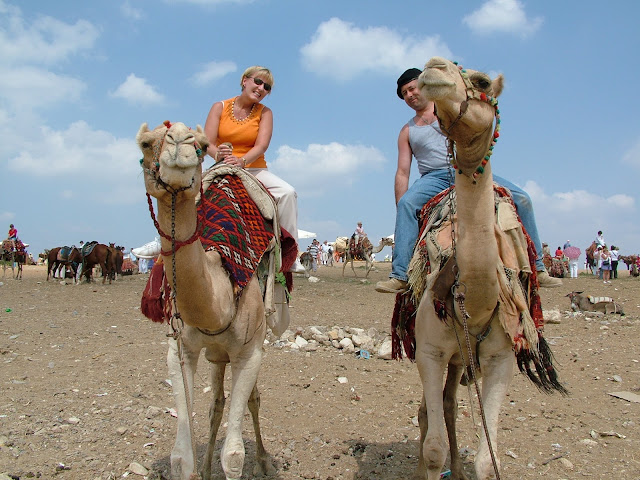
Above the Great Sphinx and one of the Great Pyramids at Giza! Below, what would a visit to Egypt be without a camel ride? I took one at the same location 20 years earlier, when I visited Cairo while stationed with the U.S. Army in what was at that time known as West Germany. 

Sunday, September 27, 2015

Two Days In Athens

While working on an article for d-Infinity Online magazine ("Monsters Among Us"), I tracked down the pictures I had taken during the trip my wife Diane and I took to the Mediterranean in 2006. Our first stop ahead of boarding a cruise ship for 12 nights was Athens, where we spent a couple of days, September 26-27, exploring the historic heart of the city. 

One thing that struck me about this trip was how relatively few photos I took, and I probably take anywhere from five to even 10 times as many a day when I travel these days. (I also shot them at a much smaller size than would be the norm for me now, which limits what they can be used for and their viability for print). It is easier, after all, to delete or ignore them later, but it is truly said that one never knows if they will pass the same way again and once you have left a place you might never have a chance to take pictures of it again. 

A highlight for us was a visit to the Acropolis of Athens, site of the Parthenon and other temple structures, which Diane had never before visited and which I had not been to since 1981. 

  Above are three views of the Parthenon, dedicated to goddess Athena Patheneos, patroness and namesake of the city. From the left are a view of the main entryway, Diane in front of renovations that were ongoing while we were there, and one from the base of the rocky hill.  Above are a closeup of the main entrance during a rare and fortuitous break in the crowds and a very touristy one of me in the foreground taken from the ruins of the nearby Roman-era temple.  While the Parthenon and the Acropolis are so associated with each other that people often mistakenly use those terms synonymously, another impressive religious structure on the site is the Erecthyon, above. Its most characteristic feature is a ceremonial porch that has a roof supported by six Caryatid columns, pillars carved in the forms of robed women.   Many of the artifacts excavated on the Acropolis are on display at a small museum there, which bears visiting by anyone wanting a deeper understanding of the site. Shown here is lord Hermes, god of communication among other things. Above left is a view of the Parthenon from the rooftop bar of our hotel. One site I have seen from a distance and wanted to visit every time I have visited Athens but, for a variety of reasons, been unable to is this beautiful 5th century B.C. temple of Hephaestus, god of craftsmen. This is a view of it from the mount of the Acropolis.  Good views of many other interesting things can be viewed from the centrally-located Acropolis. Above left are the ruins of the massive and beautiful Roman-era temple that we explored while in the city. Above right are the remains of the theatre-temple of Dionysus, god of wine, drama, and madness.  A sense for the titanic size of the Roman temple can be seen here, with Diane standing in front of it. Some the inhabitants of the temple ruins sleeping in front of an overturned column capital are a further indicator of the site's monumental scale.  We also spent some time walking around the Syntagma Square area of Athens and visited Greece's Tomb of the Unknown Soldier, above left. Above right is one of the Evzone ceremonial soldiers who stands guard in the area.  On the afternoon of our second day in Athens we took a cab to the port of Piraeus and boarded the Norwegian Jewel. A few hours after this picture was taken we sailed westward, to the Peloppenese and Olympia! 

Wednesday, August 5, 2015

Tubing On the Upper Guadalupe

Tubing itself has always looked like a lot of fun to me, but never have I driven past the hordes of teens and twenty-somethings schlepping their tubes from one end of the local spot known as the Horseshoe to the other and wished my middle-aged self was among them. That is probably a big part of why it took me and my wife more than a year of living around Canyon Lake, Texas, to get around to doing it ourselves.
            
When my two cousins Dominik Varchola and Gabriel Gavigan visited from Slovakia and England, respectively, a few years back, however, I wanted to get them out on some characteristic local activities and so started looking around for some good tubing opportunities. 

Their visit notwithstanding, I was sort of dreading the wild-and-crazy party atmosphere of the lower Guadalupe, the area so popular for tubing below Canyon Dam. And so, on a whim, I decided to scout the upper Guadalupe, the stretch of river flowing toward the lake, and was pleased to discover an outfitter, Guadalupe Canoe Livery, right where Highway 281 crosses the river.

We picked up five tubes — one for each of the people in our group and one for our cooler — loaded them onto the GCL trailer, and then rode four miles upriver to Nichols Landing, just off of Spring Branch Road and one of the drop-off points for the Texas PaddlingTrails.

Thereafter we enjoyed a beautiful, four-and-a-half hour float down the turquoise Guadalupe, past stands of ancient cypress trees, through lush riparian forest, and by looming cliffs beneath which people have lived off-and-on for thousands of years. We quickly left behind a large group that had ridden up the landing with us and were surprised how much of the time during our float there was no one else around.

“The upper Guadalupe is less crowded,” Bill Johnson, proprietor of GCL, told me during a recent chat after our float. “It’s more back-to-nature, scenic, not as trampled ... this is a family-friendly atmosphere.”

It was also a pretty relaxed atmosphere and I was pleased that we did not have to pull our tubes out of the water and haul them overland at any point.

“We will take you right up to Nichols Landing (shown below), put you in the water, and then you’ll get a four-or-five-hour float and get right out at our camp here,” Johnson said. “You can take as long as you want. We’re not saying we need you back in three hours. And if you want to do it again and you have enough time we’ll take you back up there.”

So tubing really was a blast! But for reasons that have included work and being gone much of the summers that followed I have not been back out on the Guadalupe River since. With it shaping up to be a particularly hot year, however, and my having no trips planned until the fall, I am thinking that I need to make happen again soon.

Tubing Tips
* Apply sunscreen — and then apply some more! I do not traditionally burn and thus do not tend to worry too much about doing so. After four hours of floating in a tube, however, my ankles looked like they had gotten a bit too much sun, and by the next day they were painful and blistered (and, as of this writing three days later, they still are).

* Go during the week if you can. Local outfitters are much more likely offer deals on non-weekend days during the season and, unless you want to sit in a floating parking lot with kids that are not your own, it is much less crowded then. “We have a different special every day during the week, Monday through Friday,” Johnson told me (e.g., Mondays they give $3 off on tubes until 3 p.m., Wednesdays are half-off, and Fridays kids 12 and under tube for free).

* Take sunglasses but not ones that you care too much about. There is enough glare off the water on a bright day that you need sunglasses and maybe even a cap or visor. At one point, however, I had my sunglasses off and, apparently, securely wedged in some twine wrapped around my tube. It flipped in some rough water and they were gone.

* Get the tubes with the covered bottoms! They are only a couple of bucks more than the open-bottom ones, and that is a small price to pay to keep your backside from being periodically dragged across rocks during your float. 

Sunday, March 1, 2015

On the Road from Chicago to Washington, D.C.

Am currently working on the itinerary for the road trip that my friend Brendan Cass and I will be making from Chicago to Washington, D.C., in early March! This trip ties in with a number of disparate and exciting projects that I am involved with. 

A big part of this trip for me and Brendan will be promoting our publishing company, Skirmisher Publishing LLC and visiting establishments in every state on our route where people can find our books, games, and other products. First place place we will be stopping is the Geek Bar in Chicago, a cool watering hole where customers can indulge their love for role-playing games, sci-fi, and fantasy while having a nice drink and good meal. We are still working out which other places we will be stopping at but they will include a number of game stores and, as things stand now, be in Fort Wayne, Indiana (where we will be visiting Rob Stone and his GameQuest store); Columbus and Cambridge, Ohio; Wheeling, West Virginia; Pittsburgh, Pennsylvania; Rockville and Wheaton, Maryland; Alexandria, Virginia; and Washington, D.C. 

On the way we will be keeping our eyes out for historic or interesting hotels we can stay at (including the McLure Hotel in Wheeling), eateries where we can sample good local cuisine, and unique sites that we can visit  all of which I will be writing about and commenting on here. Sites we plan on spending time at include the Field Museum in Chicago and the Kruger Street Toy & Train Museum in Wheeling, both of which I have been wanting to visit for several years. Other people can help make a good road trip what it is, and I am hoping to cross paths with paranormal researcher Dale Kaczmarek and my friend Patrick Barnes, who I met when we were each making a pilgrimage to the Normandy battlefields in France in 2004, in Chicago; some Varhola cousins in Ohio who I have traded messages with but not yet met in person; and my friends Stefan Rice, Megan Irvine, Jonathan Reichman, Rico Nardini, Chris Snyder, and J.D. Prose in Pittsburgh. 

Suffice it to say that I love a good road trip and all the cool and unique things that can be accomplished with it. Keep your eye on this spot for updates as we continue to prepare for this one and then cover the places we are visiting, staying, eating at, and adventuring in. 

Saturday, February 14, 2015

I Love Texas Hearts

To me, Texas Hill Country is a place that is very romantic, in the broadest sense of the word. With its rolling hills, deep wooded ravines, and slow-moving rivers, it seems as mysterious, ancient, and alluring as any rural Mediterranean province in Italy or France.

This romantic sensibility is most profoundly expressed, I think, by the local custom of referring to indigenous clam fossils as “Texas Hearts.” (OK, so fossilized clams might not be the most romantic thing I could have written about in recognition of Valentine’s Day, but the only other thing reminiscent of Texas I could think of would have been something related to beef hearts, to which my wife responded with “Yuck!”)

During the Cretaceous period (c. 145 million to 65 million BCE), the area of south-central Texas that we know today to be profoundly hilly was instead part of a warm, shallow sea, and inhabited, among other things, by a wide variety of now-extinct shellfish. The calcium from the shells of such creatures is what ultimately formed the native limestone that characterizes the area  to a depth of more than 1,000 feet in some places  and over the millennia it was uplifted by geological processes and gradually formed in to the land we know today.

Texas Hearts are, in short, fossilized bivalve clams that date to this extended geological period. And they do, in fact, look very much like actual hearts, and even a little bit like the stylized images that appear on Valentine’s Day cards and are used as used as shorthand for the word “love.”

The term “Texas Hearts” is sometimes also applied to fossilized sand dollars, sea urchins, and other marine organisms, but these do not actually look much like hearts at all, and are more properly referred to in my mind as “Texas Stars.” All such fossilized remains are, in any event, fairly common throughout Texas, from San Antonio to Fort Worth, and are a selling point for visitors.

“If you pay attention to where you walk in these limestone hills, you’re pretty apt to find all sorts of fossils,” the Bandera Convention and Visitors Bureau says on its website. “If you are lucky, you may even find what we call a ‘Texas Heart,’ which is a fossilized clam and looks just like a heart. Usually, they are about the size of a large apple.”

“One of the best places to fossil hunt is along the creek and river beds where the water has washed away the soil,” the Bandera CVB advises. “Another good place is along the road where the earth was cut back to build the road.” Anyone who has driven along appropriate roads on nice weekend days has very likely seen people applying this methodology.

And anyone taking an observant walk through Hill Country can find Texas Hearts and other fascinating evidence of its ancient and very different past; beyond the fossilized clams I have discovered over the last year-and-a-half, the most prized treasure I have found is the fossilized tooth of what must have been a gargantuan shark.

Not everyone’s own heart is, of course, stirred by such things … But, if yours is, then you will likely enjoy Texas Hill Country all the more.

Happy Valentine’s Day! 

Sunday, January 25, 2015

A Haunted Roadtrip Through San Antonio, Austin, and Texas Hill Country

To anyone who followed my travels over the summer, particularly the Aegean Odyssey that took me to Athens and five islands of Greece in August, it might seem that I have been uncharacteristically quiet for the past few months. Amid a particularly busy year of travel, conventions, and speaking appearances, however, I have been working to finish up my Ghosthunting San Antonio, Austin, and Texas Hill Country, the latest title in publisher Clerisy Press's America's Haunted Road Trip of guides to reputedly haunted places people can visit. Anyone interested in the fascinating history and ghostly lore of this area should be sure to pick up a copy of this book when it comes out and in the meantime can find previews of most of its chapters at the site dedicated to it

As of this writing I have submitted all the chapters and most of the front and back matter to my editors and have just two miscellaneous sections to finish up for Ghosthunting San Antonio, Austin, and Texas Hill Country.

I have organized the 27 feature-length chapters into four sections, San Antonio, which includes downtown and everything within the 1604 Loop that surrounds the city; Greater San Antonio, which includes sites in the counties surrounding the city; Austin, which covers sites in the state capitol; and Texas Hill Country, which covers sites in the wooded highlands to the north and west of the city. In addition to its 27 feature-length chapters, it was also important to me to include a robust section of Additional Haunted Places that has brief writeups on another 60 sites throughout south-central Texas, which helps give this book a comprehensive nature. I will also support it indefinitely through the Ghosthunting San Antonio, Austin, and Texas Hill Country blog, which will include things like historic images of sites, new things I learn about places covered in the book, additional haunted sites I discover, and my ongoing paranormal adventures in the title area.

As things stand now the release date for the book is set for September 24, 2015. That might sound like a long time, but a lot of editing, layout, design, promotion, and marketing needs to take place between now and then. I have also got an exceptionally busy new year scheduled already, to include a roadtrip from Chicago to Washington, D.C., in March — which I will, of course, cover here with articles and photos! 


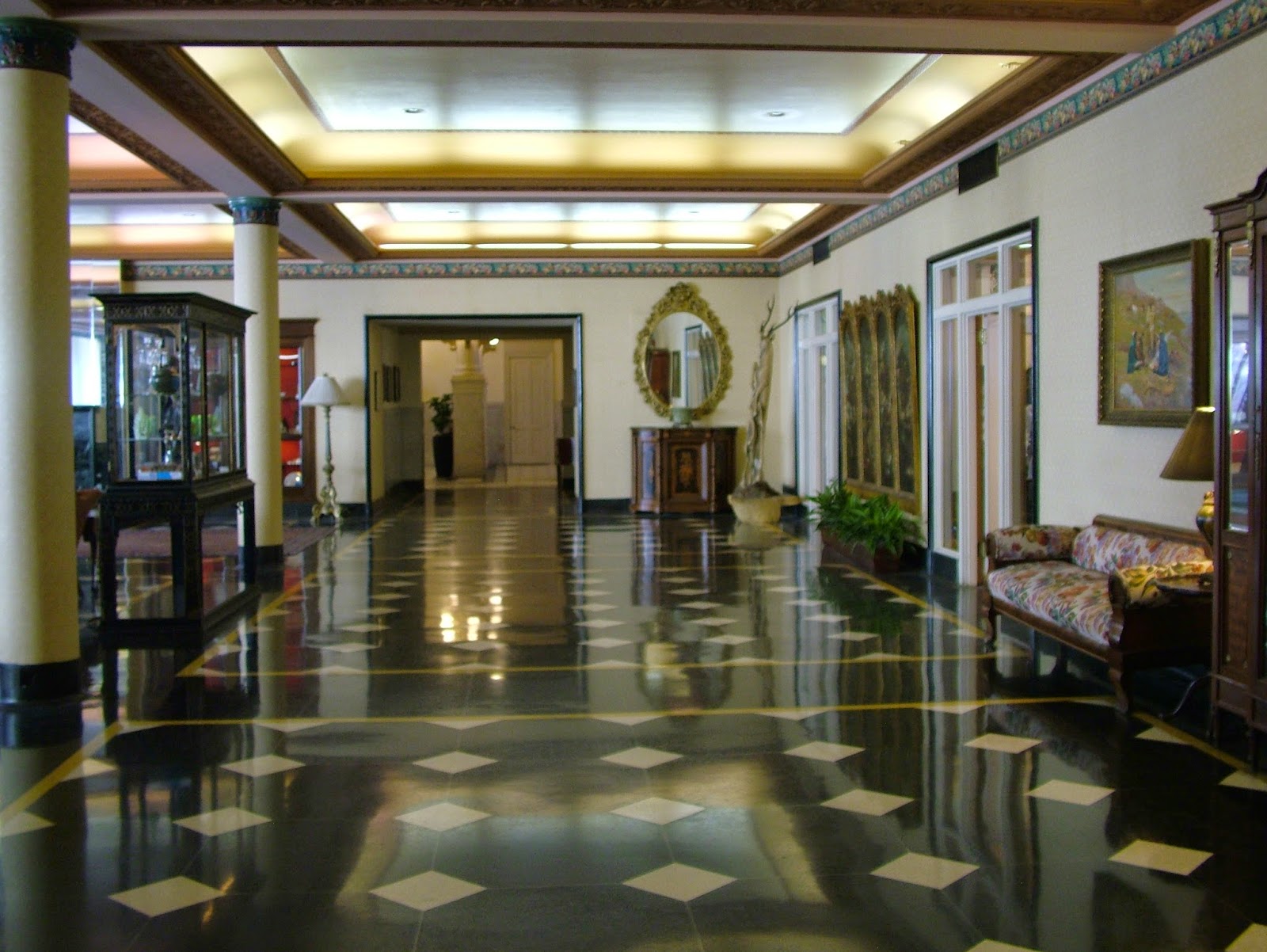
Top, the entrance to what is now the giftshop of the Alamo, which has long been believed to be haunted by the spirits of its slain defenders. Above, the sumptuous lobby of the Menger Hotel in San Antonio, which has a ghostly history going back to the middle of the 19th century. 

Thursday, December 18, 2014

On the Trail of 'The Lord of the Rings'

I originally posted this piece about "Lord of the Rings" and "Hobbit" sites in New Zealand on October 24, 2013, shortly after I visited them. With the release of the the final segment in the Hobbit trilogy, however, I thought it would be appropriate to update this one a little and post it again! 

WELLINGTON, NEW ZEALAND  One of the most enjoyable things I did on my recent trans-Pacific voyage from Honolulu, Hawaii, to Sydney, Australia, was to take a tour in Wellington, New Zealand, that took me to a number of the sites where The Lord of the Rings and Hobbit movies were filmed, to include a visit to Peter Jackson's Weta Studios! Following are some representative photos from this experience. The New Zealand fantasy film industry was, in fact, one of the things I spoke about during my tour of duty as Destination Lecture about the Royal Caribbean International vessel Radiance of the Seas, and is one of the things I will spoke about at a number of 2014 conventions, including Dallas Comic & Pop Expo (March 1-2) and Comicpalooza (May 23-26)Above right is the entrance to the municipal park where several of the scenes associated with the departure of Frodo, Sam, Merry, and Pippin from the shire were filmed. 

 
Above left, Ted Guise of Wellington Movie Tours displayed on a laptop scenes filmed at the various spots we visited. Above center, a scene from the Lord of the Rings shot in the tree pictured in the upper right corner of the first image; above right, me and Diane Varhola recreating the scene in question with props provided by Guise.  

Above left, Guise also brought story boards depicting stills from The Lord of the Rings, this one showing the scene in which the Hobbits roll down the hill into the woods after being chased by Farmer Maggot. Above right, our recreation of Frodo and the Hobbits where they landed on the road, played by me and a trio of au pairs. 

Above left, in the foreground four tour goers recreate the actions of the Hobbits as they hid below the road, while in the background four others represent the Dark Rider, its horse, and the roots and tree depicted in the scene — which were artificial and created for the film! Above center, the clever Guise showed our group how to replicate the image of a Dark Rider in silhouette. At right, our actors can be seen in their guise as a Dark Rider. 

Above and below left, some of the life-sized Troll statues displayed at the Weta Cave, which provide ample opportunities for amusing fan photography. 

Above center, the Weta Cave has on display numerous props and models from The Lord of the Rings and other movies produced by the studio. Above right, we had the opportunity to go beyond the red door while we are at Weta Studios, where we learned about props and models created for their movies! Photography was not allowed but anyone who cares can buy me a beer and I will tell them about all the wonderful things we saw there.  

Above left, a glimpse at the massive green screen at Weta Studios — note that the wall it is built on is made of stacked up-shipping containers! Above right, some of the rocks along the shore of Wellington Harbor that were used as models for the stonework in the lair of Shelob the giant spider. 

If you are in Wellington, New Zealand, or will be visiting it, be sure to check out the Lord of the Rings tour to see all of this and more yourself. Otherwise, be sure to check out one of my great presentations during the convention season in 2014!