Tuesday, September 4, 2012

Wine Diary

One of the things I enjoy sampling when I travel is the local wine (along with beer and other beverages, for that matter). And, one of the ways I like to travel vicariously when I am at home is by drinking wines from various faraway places. So, I am probably overdue launching a wine diary on this site that lists what I have been drinking, what it went well with, and other details that might be of interest to readers. I will be striving primarily to provide useful information rather than the often baffling and arbitrary comments that accompany many standard wine reviews. Listed in parentheses are the dates I and/or my wife consumed the vintage being discussed. Questions and comments are welcome!

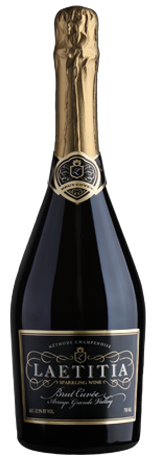
Laetitia "Brut Cuvee," c. $16. (December 1, 2012). It has become fashionable in recent years to dismiss champenoise-style wines as generally disappointing and consumed only by bourgeois people who don't know any better. Fortunately, I am neither fashionable nor bourgeois, I do know better, and I truly enjoy a nice glass of sparkling wine, so I was glad to discover this particular vintage. This decent cuvee is a blend of Chardonnay, Pinot Blanc, and Pinot Noir that, as its vintner says, is "complex, elegant, and youthful," and which is fairly dry and tart, with hints of citrus. I expect it would pair especially nicely with salmon, trout, or other freshwater fish but, admittedly, enjoyed it only as an aperitif (one bottle serving me in this capacity over the course of three days).

Jumilla "El Campeador," 2011, c. $16 (November 29-30, 2012). I was looking for a nice wine to pair with homemade tapas one evening and made a good choice with this Spanish Syrah/Monastrell/Petit Verdot blend, a complex, semi-dry, medium dry red wine with a somewhat tanniny finish. Its name, "the champion," is according to the vintner a tribute to the hero El Cid (appropriate in that he was noted for striving to drive a teetotaling people off the Iberian peninsula). I think it would go well with just about any sort of Mediterranean style food, and I enjoyed it with some chick peas broiled with sesame oil and red pepper. As much as any red wine, and moreso than many, this vintage benefits from breathing a little while before drinking.

Castello del Poggio "Moscato D'Asti," 2010, c. $16 (September 2012). What is it about certain Italian white wines that they have the effect of putting me in a good mood? Maybe it is the very slight fizziness characteristic of some of them, subtle enough in the case of the vintage I am writing about here that I might not even have consciously noticed if I had not opened the opened the bottle and poured a glass myself. This delicious, full-bodied sweet white wine is superior for its type and is full of fruit flavors with an emphasis on fresh melon and hints of honey. It is wonderful as either an apéritif or a desert wine, and I enjoyed it both alone and with some ripe green grapes and think it would pair very nicely with many other sorts of fresh or dried fruit (although I would not recommend it as an accompaniment for any sort of actual meal, based on my preferences for drier vintages with most food).

Frei Brothers Reserve "Alexander Valley Cabernet Sauvignon," 2008, c. $22 (February 25 and March 1, 2012). My wife and I cracked open this nice bottle of red wine -- which our friend Jon Reichman brought us during his recent visit to Texas -- to accompany a marinated sirloin steak that we grilled one Saturday night and enjoyed with sweet peppers sauteed with goat cheese and some white rice. We only drank about two-thirds of it and I finished up the balance of it five days later with a simple dinner consisting of it and a plate of macaroni-and-cheese.
It is a fairly dry, full-bodied wine with a complex palette of flavors and complemented both meals perfectly. I have been partial to Alexander Valley wines since about 2000, when my friend Chip Cassano and I drove through it during a road trip up the West Coast, and recommend this appelation in general and this product of it in particular.

Tangent Winery "Sauvignon Blanc," 2009, c. $16 (February 29, 2012). My wife selected this wine to accompany spaghetti with a vegetarian sauce made with artichoke hearts, tomato, onion, and garlic, and in that it was tangy and not sweet it paired perfectly. We had some dried pineapple for desert with our second glasses but, while this sort of fruit is a nice accompaniment to many white wines it was a bit too sweet to go well with this one. "This vintage is bright and racy, with flavors of passion fruit, pear, lemon and grapefruit," says Christian Roguenant. "Minerality notes, lively acidity, and green grassy elements balance the wine nicely. It finishes long with a touch of zesty lime. My favorite wine with oysters, it pairs well with most all seafood." I agree on all counts and look forward to trying this one with some fresh oysters!

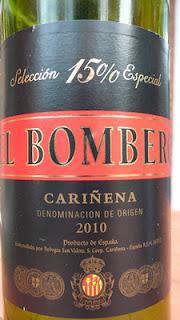
Carinena "El Bombero Seleccion 15% Especial," 2008, c. $16 (February 24, 2012). This is a fun and particularly potent Spanish red grenache wine, in that it has a 15% alcohol content, as compared with the almost universal 12.5% for other vintages. We enjoyed this with grilled pork shortribs -- a fairly heavy meal -- and this full-bodied, slightly hot-to-the-tongue wine paired very nicely with them.


Tenuta Ca'Bolani "Prosecco," 2010, c. $16 (February 19, 2012). This Italian frizzante wine was, on top of everything else, a fun surprise for us, in that we were not paying particular attention and were expecting it to be a regular white wine. I had actually been feeling a bit down and felt immeasurably more upbeat just one sip into a glass of this nice northeastern Italian "champagne."
While it had a bit of a fruity finish, it was dry enough that it paired nicely with our broiled steelhead salmon (I loathe sweet wine with most food and so was sensitive to how well this would accompany a meal). For desert we had some strawberries and dried pineapple, both of which compliment many white wines in general and a decent sparkling wine in particular. According to the vintner, it is "gently pressed and vinified at low temperature to retain the lively, fresh, aromatic orchard fruit, white blossom, and sweet almond character."

Saturday, August 25, 2012

America's Allied Wounded Warriors

The following story does not contain any tips for travel but is inspired by some significant things I learned during my recent trip to the Czech Republic, and will likely resonate with anyone interested in the issue of wounded warriors or the ongoing U.S. military presence in Afghanistan.

As a journalist, I have always been aware that the United States was not alone in the ongoing operations in Afghanistan and Iraq. Knowing that in theory, however, does not necessarily make one think about the non-American troops that are not just serving alongside U.S. military personnel, but being killed and maimed like them as well. I was exposed to this largely unknown phenomena and gained some insights into it when I visited the Czech Republic in July. Since then, I have been moved to begin writing a book on the subject with the working title Allied Soldier and to begin telling the story of the things I saw and the people I met. (Shown here is a Czech soldier guarding the presidential palace in Prague.)

There are, in fact, currently more than two-dozen nations serving with the United States in Afghanistan, including Great Britain, France, Germany, and the Czech Republic. This is, moreover, the first time the Czech Republic has been involved in hostilities since World War II and it faces many obstacles to providing adequate support for its soldiers severely injured as a result. One of these hurdles is that many of the nation's citizens do not understand the value of supporting either the war in Southwest Asia or the veterans wounded in it. Another is that the Czech government does not have either the resources or the breadth of experience of larger, wealthier nations like the United States, which can draw upon the lessons it has learned in the many conflicts with which it has been involved over the past six decades.

Two years ago, a number of concerned Czech citizens founded REGI Base Foundation, an organization dedicated to providing critical resources and support for wounded warriors that goes beyond what either the government or their families are able to do. Its centerpiece will be REGI Base I, a state-of-the-art medical facility currently under construction outside of Prague in the village of Svémyslice that, when it is completed, will be able to house up to 16 veterans undergoing treatment and serve the needs of up to 35 outpatients per day (the facility is shown here as it appeared during my visit). The intent of its founders is that it will include modern diagnostic equipment unavailable anywhere else in the region, be able to provide rehabilitative care onsite, and serve as a clearinghouse of information on physicians and clinics worldwide to which it can send wounded warriors in need of specialized care.

Inspiration for both the name of REGI Base and its mission is Chief Warrant Officer Jiří "Regi" Schams, a Czech special forces soldier who was horribly wounded on March 17, 2008 (shown here shortly before his injury). On that day, he was part of a 13-person multinational team that was conducting outreach operations to the civilian residents of a particularly dangerous province of Afghanistan when it was attacked by a suicide bomber. Four of the other personnel in the squad were killed outright, including two Danish civil affairs soldiers and the group's Afghani interpreter, and nine were wounded, including Schams, who was incapacitated by the blast. It initially appeared as if he had suffered some relatively minor injuries and a concussion. Before long, however, it became apparent that a piece of shrapnel had entered the back of Schams' head and burrowed its way through his brain almost to the front of his skull.

At first, there did not appear to be much chance that Schams would survive. But to the surprise of everyone — including his doctors and his family — the phenomenally tough special operations soldier managed to stabilize and pull through. That brought its own host of problems, however, for the injured veteran, who suffered extreme neurological damage and was thereby confined to a wheelchair, initially unable to speak, and plagued with vision problems that force him to perpetually keep one eye closed.

Following his return to the Czech Republic, Schams received the best medical care that his government could provide, and enjoyed the attention and support of his former comrades-in-arms and family members, particularly his mother. But resources available to him were inadequate for dealing with his condition, and his recovery was slow and very limited; for the first two years after he was injured, Schams believed he was in the middle of a nightmare from which he would eventually awake, something that severely retarded his progress.

In 2010, a Czech entrepreneur named Hynek Čech met Schams through a mutual friend and was horrified to discover that the wounded warrior was living alone in a high-rise apartment building that he could not even exit on his own (Schams is shown here with REGI Base co-founder Hynek Čech, right, and Kent Wills, author of a story about the wounded veteran titled a "A Soldier for Life").). His situation improved a little when friends would visit or take him somewhere, when he would stay with his mother on the other side of town, or when he would go for an annual two-week course of therapy at a nearby military hospital, but was still far from ideal. At both his and his mother's apartments, for example, the elevators are barely large enough to accommodate a wheelchair and can only be accessed via flights of steps — making it difficult for him to come and go even if someone is helping him. He also has trouble using the toilet or bathing without assistance.

Čech began looking into what could be done on behalf of Schams and other wounded warriors and soon came to the conclusion that the only thing that would work is a completely new, private organization that both supplemented the available treatment and services and went beyond them. It was this realization that prompted him to help conceive of and become one of the co-founders of the REGI Base Foundation.

One of the very first thing the fledgling organization did was to take Schams to a special neurologic clinic in the Black Sea city of Odessa, in the Ukraine, so that he could be tested by a top specialist in brain injuries (that doctor had, ironically, served in a Soviet military field hospital in Afghanistan from 1982-84, during that nation's ill-fated occupation of the country). After being examined and receiving additional CAT scans, the medical staff at the facility recommended that Schams be sent to a military rehabilitation center in the Ukrainian city of Saky. He spent six weeks at the facility and, as a result of the treatment he received there, his speech improved significantly.

That was the limit of what could be accomplished for Schams in either the Czech Republic or the Ukraine, however, and the staff of REGI Base realized they needed something better. So, in January 2012, Čech traveled to TIRR Memorial Herman in Houston, Texas (shown here), where a dozen Romanian soldiers had recently received treatment for traumatic brain injuries, and the costs for this had apparently been covered by the U.S. government. The best that hospital representatives were willing to do, however, was to give REGI Base a quote of nearly a half-million dollars to treat Schams — something that closed the door on help for this allied soldier.

Despite this frustrating setback, REGI Base has continued to move ahead in its attempts to provide help for both Schams and other critically-injured soldiers.

“Our fundamental idea is to create a unique complex that will combine rehabilitation, accommodation, and 24-hour assistance for soldiers who have returned from overseas missions but who cannot be adequately cared for by their families or friends," said Čech (shown here at his office in Prague). "Our first priority is to provide 365-day-a-year service to soldiers who cannot be fully treated at home or by the government. The Czech Republic currently has more than 500 soldiers deployed in Afghanistan and, as something tragic can happen at any time, we need to be ready to provide special care when it is needed.”

Čech also emphasized that, once it is established, it is his intent that the facility will serve as a regional rehabilitation center that serves the needs not just of military personnel from the Czech Republic but other nations as well, including the United States and other NATO nations. Ultimately, he said he would like REGI Base to have branches worldwide and to established reciprocal agreements that would allow military personnel to receive the treatment most appropriate to them at facilities in any of the participating nations. And going beyond medical care, Čech is also actively lobbying in his country for legislation that would help provide jobs for discharged Czech veterans and working on a project to provide special insurance benefits to them.

During my visit to the Czech Republic, I met with Schams and his mother; Čech and his staff; Schams former commander, Major Pavel Ruzicka, currently second-in-command of the Czech military police corps; Special Operations Group members who served with Schams (most of whom cannot be mentioned by name or photographed because they are still on active duty and involved in classified operations), and Deputy Minister of Defense Michael Hrbata (who appears with me here in his office at the Ministry of Defense). Hrbata in particular has been a champion of REGI Base, as has his boss, Defense Minister Alexandr Vondra — who gave the initial "green light" for the veterans organization — and the two of them have done everything in their power to garner support for it from the government and amongst the Czech people.

What really struck me during my visit, in fact, was how everyone concerned was doing everything in their power to help Jiří Schams and soldiers in a similar situation, but how so much more was needed (Schams is shown below as he appears today). REGI Base has got a handle on what those additional measures are, and when I visited the site of the clinic under construction and heard about all the great things the foundation wants to do, my response was, "Let's get this done! What do you need?"

As with almost anything big and complicated in the modern world, of course, what REGI Base needs is funding. It has thus far raised hundreds of thousands of dollars for its facility outside of Prague and, in the course of moving ahead with it, has just added a third level to the main building. It needs millions more, however, to complete construction, purchase expensive diagnostic equipment, and get treatment for Schams at TIRR Memorial Hermann in Houston. In the meantime, the war continues, billions of dollars go every day toward its prosecution, and, every week, more soldiers, allied and U.S. alike, join Schams among those who will need a lifetime of care as the price for their sacrifices.
Wednesday, August 8, 2012

Space City Con (Houston, August 10-12)

If you have not got any plans this weekend, or are going to be in the Houston area anyway, then you are not going to find anything more fun and exciting to do then go to Space City Con! I will be a there as an "author guest" of the convention and giving talks on various things related to fantasy literature in general and his books in particular, and my Skirmisher Publishing LLC and d-Infinity game magazine will also be exhibiting and running events.

Being held at the Westin Galleria hotel and convention center August 10-12, this event is an all-ages fan festival of comics, sci-fi, fantasy, gaming, literature, and art. According to its organizers, it is a "geek festival with free parking" for which they have attempted to "put on the best convention possible for current generations of fans and instill a love of comics, sci-fi, and fantasy in the next generation."

Space City Con is the Gulf Coast’s newest fan culture convention, offering a robust mix of authors, artists, sci-fi, fantasy, comics, gaming, fan group networking, literature, writing workshops and more, and has specifically been designed to be family-friendly.

Venue for this event, being held for the first time this year, is the fourth largest mall in America, in the fourth largest city in America. Galleria Mall boasts 375 stores, a large food court, ice rink, and a wide variety of restaurants.

Just as Houston has a broad economic mix in aerospace, energy, manufacturing, transportation, it also boasts the world’s largest concentration of healthcare and research institutions. It also has the top-ranked port in the United States, has always been home to a large international community, and is home to famous NASA Johnson Space Center and Mission Control.

"Space City Con will be a gathering of fans of all ages, with an exchange of pop culture passions," said founder George Comits. "More than entertainment, a place to escape for a while, forge lasting friendships, and connect with talented creators across a spectrum of genres."

During this inaugural year, Space City Con is embracing the Kids Need to Read foundation, as its founders say they consider "these elements as fuel for creative thinking, vocabulary, reading comprehension, and most of all, expanding the boundaries of what is known, into dreams and a yearning for what is unknown, what is unseen … but can be painted by the incredible human mind and spirit."

Space City Con wants to pass on the torch from one generation to the next, echoing the cry for “Inspiring Imagination!”

Wednesday, July 25, 2012

Eating and Drinking in New Orleans

NEW ORLEANS -- One of the reasons my wife and I came to New Orleans was to experience its unique and famous cuisine! We have, in fact, had a number of decent meals here along with a few exceptional ones, and I will provide an overview of them here. And over the course of a week we have actually only had one bad experience that bears mentioning, our wretched breakfast at Montrel's Bistro, bad enough that it warrants its own article and which will hopefully save a few unsuspecting souls from its indolent clutches. We also visited world-famous Café du Monde, an establishment that deserves its own entry for entirely positive reasons.

Pat O'Brien's (718 St. Peter Street)
This local watering hole is known for its mixed drinks, and we repaired to this establishment to sample some of them and sooth our jangled nerves after our irritating experience at Montrel's Bistro. Diane had the specialty of the house, its aptly-named Hurricanes, and I opted for my first-ever Mint Julep; there are, after all, so few things one can do for the first time at the age of 45 that they should not pass up the opportunities to do so. (Shown above is Pat O'Obrien's mascot by its Bourbon Street entrance; I am actually working on a coffee table book depicting nothing but my wife posing with creepy streetside mascots, a project in which she is almost inexplicably uninterested.). We sat in the establishment's pleasant courtyard and, while we were not up for eating anything during that visit, thought the food looked good enough that we came back to try it the next day.
On our second visit we sat in a semi-open dining area and I ordered a glass of red wine and the Shrimp and Grits (shown at left), something I had never tried before but wanted to, and Diane ordered the Cancun Shrimp starter and an Abita strawberry ale. The food was all good --high point for me being the fried cakes of cheesy grits, crispy on the outside and soft on the inside -- and Diane especially enjoyed her beer, vowing to pick up a case of locally-brewed Abita on the way out of town.

GENERAL TIPS
* Wine tends to be less of a good deal than beer in many New Orleans establishments! We were generally seeing prices, for example, of around $4.50 for a local Abita beer in many places, as compared to $7.50 for a small glass of unexceptional house jug wine. The fact that I just prefer wine to beer with many sorts of food was my downfall here ...

Tuesday, July 24, 2012

Café du Monde

NEW ORLEANS -- One of the world-famous institutions visitors to the city should be sure to partake of is Café du Monde, a coffee shop established a full 150 years ago during the U.S. Civil War (as per the sign my wife Diane is peering at toward the bottom of this page). It is located on Decatur street, just a block from the banks of the Mississippi River and at the west end of the French Market, Café du Monde was established in 1862.

Café du Monde is patronized by tourists and locals alike, who come to enjoy its French-style beignets and New Orleans-style café au lait blended with chicory. A beignet, by the way, is a pillow of fried choux dough, crispy on the outside and soft on the inside, covered with powdered sugar, and served fresh to order at the café (they are kind of like a classy version of the fried dough that can be purchased at state and county fairs nationwide). Other than a few other sorts of beverages there is nothing else on the menu, a reminder that some of the best pleasures are also the simplest ones. Interestingly, its beignets have been certified kosher since 2008! That probably makes them halal, too. So, beignets can be enjoyed by everyone.

During our online research ahead of visting Café du Monde we noted that a number of people had complained bitterly about having to wait as much as two hours to obtain a table and their beignets, but a little legwork revealed just how inane this was. Yes, when we walked past the cafe on Saturday afternoon there were what looked like two-hour lines in front of it. But when we went there around midday on Tuesday we sat right down and had our treats and drinks in front of us within minutes.
Café du Monde is, in fact, open 24 hours a day and seven days a week, except for Christmas Day and when the city is getting slammed with hurricanes. So, if you waiting two hours to get your cafe au lait and beignets then you either want to suffer or are too clueless to how to keep from doing so.

Enjoy! I would not have wanted to miss my first beignet during my first trip to New Orleans and recommend that visitors to the city also have their first at the place most famous for them.

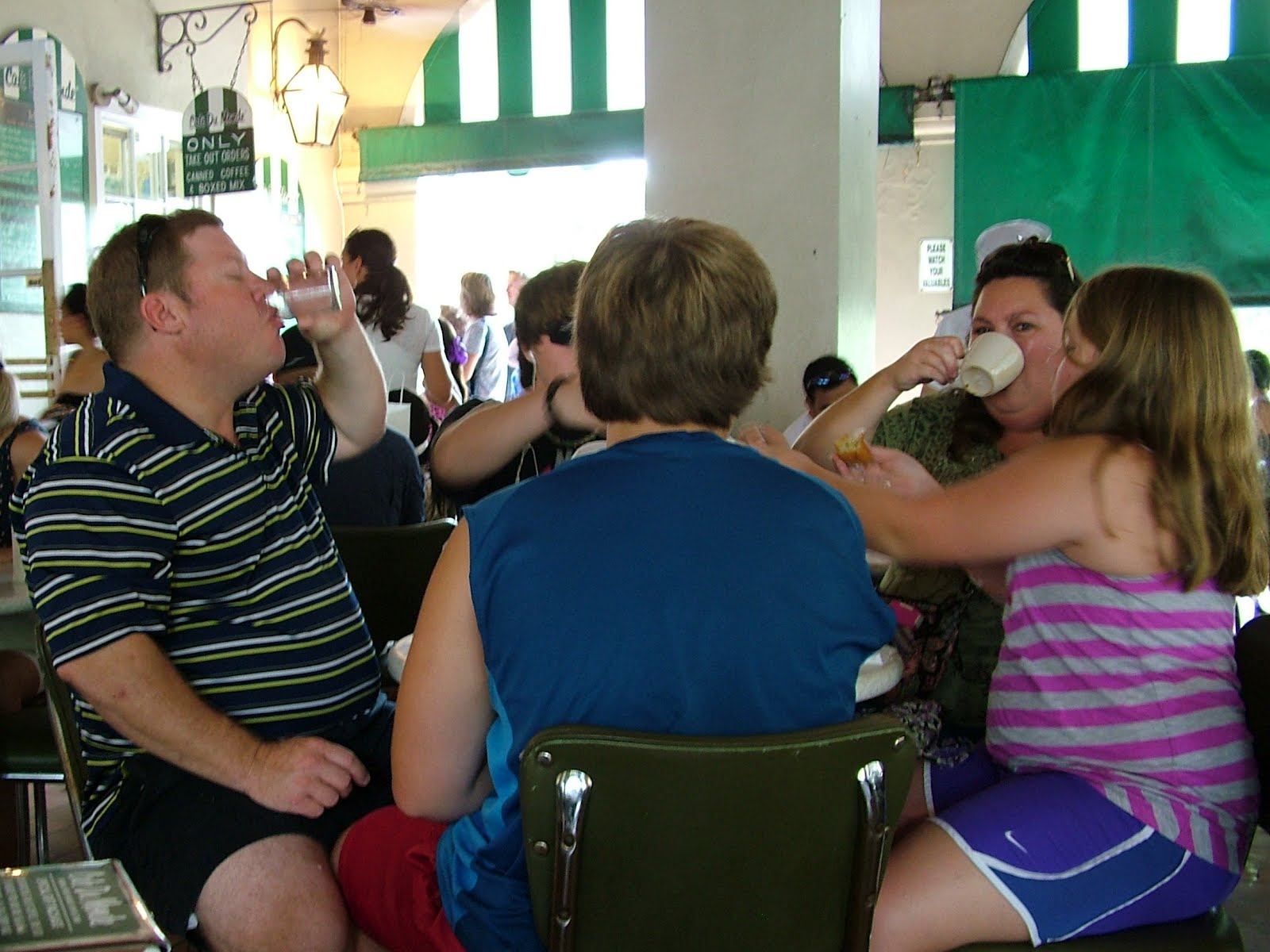
Nom, nom, nom! This family sitting near us especially relished their big plates of beignets. But how can you not like something that is deep fried and then buried under a mound of powdered sugar?

St. Louis Cemetery No. 1

NEW ORLEANS -- One of the must-visit places in this city for ghosthunters or anyone interested in architecture in general or burial grounds in particular is certainly St. Louis Cemetery #1. This crumbling, above-ground graveyard has been in continuous use since the 18th century. It bears mentioning that the cemetery is only open until 3 p.m. on most days, and just noon on Sundays and holidays, so plan accordingly!

This is the main entrance to the cemetery. There are a number of other gates but this is the only one that appears to be open to the public.

"When New Orleans was founded in 1718 burials were made on the river bank. The first cemetery, in 1721, was on St. Peter Street. Burials were also made in the church. The first cemetery was demolished when this cemetery, St. Louis Cemetery No. 1, was established by Spanish royal decree of August 14, 1789. As the city grew St. Louis No. 2 was established on Claiborne Avenue in 1823 and St. Louis No. 3 on Esplanade Avenue in 1854. New Orleans Archdiocesan Cemeteries 1983

Wow, check out that orb! Hah, I wish. This is what happens when you have sunshowers during an investigation ...

Fans of horror author H.P. Lovecraft will likely know exactly what I mean when I say this picture makes me think of the short story "Pickman's Model" ...

Wandering around in the maze of tombs that is St. Louis #1 can give the visitor an otherwordly feeling, and it is very easy to forget that the whole place is just the size of one city block.

This ornate group tomb holds the remains of members of an artillery company, which would likely have more-or-less served as a club for affluent gentleman (i.e., those able to afford cannons). The finials on the posts surrounding the tomb depict flaming bombs.

The tomb of "Voodoo Queen" Marie Laveau, to this day an object of veneration that is surrounded with votive offerings of all sorts. While we were there I say some visitors examining these but would not presume to do so myself ...

Monday, July 23, 2012

Haunted History Tours' Ghost Tour

NEW ORLEANS -- As a paranormal investigator, one of the first things I like to do when checking out the supernatural activity in any particular city is take the local ghost tour. Some are good, some are bad -- and some are the real deal. And that is most assuredly the case with Haunted History Tours, a company that takes its participants to real sites throughout New Orleans associated not just with ghosts, but also voodoo and even vampirism (no, the Big Easy's role as a reputed haunt for bloodsuckers did not start with Anne Rice).

On the day we took our ghost tour of the French Quarter, my wife Diane and I met with Haunted History Tours founder Sidney Smith outside of Rev. Zombie's Voodoo Shop (shown at left, during a daytime lull in the action), just a few blocks from the chaos of Bourbon Street. It would literally be fair to say that he helped "write the book" on paranormal activity in New Orleans, as he collaborated on author Kalila Smith's New Orleans Ghosts, Voodoo, and Vampires, a must-read primer for anyone interested in any of the title subjects. Using everything from crime reports, to historic records, to first-hand accounts, he and his staff have meticulously researched the haunted histories of the sites to which they take tour-goers.

All of Haunted History Tours' guides look pretty good but I would still say that we were lucky to get Jesse St. Croix, a native of witch-haunted Salem, Mass., who visited New Orleans in 1975 and decided he never wanted to leave. He brings a winning combination of knowledge, passion, and showmanship to the tours he leads, making them as informative as they are enjoyable. Over a two-hour period, St. Croix led us through the humid, darkened streets of the French Quarter to a number of the most significant haunted places located there.

Foremost among the places we visited was certainly the LaLaurie Mansion, a hulking edifice whose whose socialite lady had tortured to death dozens, perhaps even hundreds of slaves in the mid-19th century. It has been considered to be haunted from the day the crimes committed in it were discovered and has had such a disturbing effect on people since then that most recent owners -- including actor Nicholas Cage -- refuse to spend the night in it. (For those interested in ostensible paranormal phenomena, note the two small orbs in the right half of the picture, both of which appear to have faces on them.)

Other haunted locales we visited on the tour included Muriel's, a haunted restaurant; the home of Civil War General P.G.T. Beauregard; the Andrew Jackson Hotel (shown here); a haunted bar; and the home where a mulatto mistress froze to death on the roof while trying to entice her master to marry her. The evils of slavery, intemperance, and greed have imposed their legacy not just upon the visible history of New Orleans, but upon its haunted one as well, and the time we spent with St. Croix gave us some fascinating and disturbing insights into that.

There is more to come! Keep your eye on this space for more details about the places we visited on the French Quarter ghost tour -- and for an account of Haunted History Tours' Vampire Tour!